

WARNING: The devil does not want you to complete this Study Guide!
A tattooed number, a computer chip under the skin, or something subtler? It’s one of the most misinterpreted prophecies in all of the Bible—yet it is vitally important to understand it. In studying the mark of the beast, we must address some sensitive issues, naming names and being specific. This is not a popular thing to do, but we must be firm because God loves His people and wants them to know the truth. This message is not from us; it comes from Jesus. And with eternal death facing those who receive the mark, it would be wrong to not help Him deliver this message. So please read Revelation 13:1–8, 16–18, and 14:9–12, and pray for the Holy Spirit to grant you an honest and understanding heart before embarking on this study adventure.
An Urgent Reminder
We learned from Study Guide 2 that a terrible conflict is in progress between God and the devil. It has raged through the centuries since Lucifer, heaven’s most powerful angel, rebelled against God. With the angels who joined him, he attempted to seize control of the universe. God and the loyal angels had no choice but to eject Lucifer and his angels from heaven. Lucifer, who became known as Satan, was infuriated. His determination to control the universe has only grown since. Amazingly, he has won the support of the majority of earth’s people in his rebellion. The Lord also asks for people’s loyalty and support, but He leaves all free to choose. Soon every person on earth will have aligned with either Satan or God. The final battle between Satan and God is just ahead, and it is described in the book of Revelation. This prophetic book points out that God has an emblem, a mark, that will identify His people. Satan also has an emblem, a mark, that will identify those who support him. As usual, Satan will work through an earthly power—symbolized in Revelation by a beast—to impose his mark. This Study Guide will reveal the beast’s mark, which every lost person of the end time will receive. Unless you know what his mark is, how will you avoid receiving it?
1. In order to know what the mark of the beast is, we must first identify the beast. How does the Bible describe it?
Answer: A. It rises from the sea (verse 1).
B. It is the composite of the four beasts in Daniel chapter 7 (verse 2).
C. The dragon gives it power and authority (verse 2).
D. It receives a deadly wound (verse 3).
E. Its deadly wound is healed (verse 3).
F. It is a strong political power (verses 3, 7).
G. It is a strong religious power (verses 3, 8).
H. It is guilty of blasphemy (verses 1, 5, 6).
I. It wars with and overcomes the saints (verse 7).
J. It rules for 42 months (verse 5).
K. It has a mysterious number—666 (verse 18).
Do some of these points have a familiar ring? They should! You encountered many of them earlier when we studied about the antichrist in Daniel chapter 7. The “beast” introduced in Revelation 13:1 is simply another name for the “antichrist,” which we learned from Daniel 7 is the papacy. Prophecies in the books of Daniel and Revelation are often presented multiple times, with details added each time to encourage accurate interpretation. So expect to learn some new things about the antichrist from this Study Guide. Now let’s consider, one by one, the 11 points that describe the beast...
A. It would rise from the sea (Revelation 13:1).
The sea (or water) in prophecy refers to people or a populated area (Revelation 17:15). So the beast—antichrist—would arise amid the established nations of the then known world. The papacy arose in Western Europe, so it fits this point.
A Word of Explanation
In harmony with God’s command to honor all people (1 Peter 2:17), we pause here to recognize the papacy for her many good deeds and activities. Her hospitals, orphanages, care for the poor, homes for unwed mothers, and care for the aged are appreciated universally. She can honestly be lauded for many things. But, like all other organizations, she has also made serious errors. God pinpoints some of these errors in Revelation. The Lord, who blesses and comforts, must sometimes chasten and correct. Please ask His Spirit to speak to you as you continue studying this crucial topic.
B. It would be a composite of the four beasts of Daniel chapter 7 (Revelation 13:2).
Study the comparison below to see how it all fits together:
| Daniel chapter 7 | Revelation chapter 13 |
| Babylon | Lion-like beast (vs. 4) | "Mouth of a lion" (vs. 2) |
| Medo-Persia | Bearlike beast (vs. 5) | "Feet of a bear" (vs. 2) |
| Greece | Leopard-like beast (vs. 6) | "Like unto a leopard" (vs. 2) |
| Rome | Ten-horned beast (vs. 7) | "Having ... ten horns" (vs. 1) |
The four beasts of Daniel 7 are depicted as part of Antichrist, or the beast, because the papacy incorporated pagan beliefs and practices from all four empires. She clothed them in spiritual garb and spread them to the world as Christian teachings. Here is one of many supporting statements from history: "In a certain respect, she [the papacy] has copied her organization from that of the Roman Empire, has preserved and made fruitful the philosophical intuitions of Socrates, Plato, and Aristotle, borrowed from both Barbarians and the Byzantine Roman Empire, but always remains herself, thoroughly digesting all elements drawn from external sources." 1 This point definitely fits the papacy.
C. The beast must receive its power, seat (capital), and authority from the dragon (Revelation 13:2).
To identify the dragon, we go to Revelation chapter 12, where God's end-time church is pictured as a pure woman. In prophecy, a pure woman represents God's true people or church (Jeremiah 6:2 Isaiah 51:16). (In Study Guide 23, we will present a detailed study of God's end-time church of Revelation chapter 12. Study Guide 22 explains Revelation chapters 17 and 18, where fallen churches are symbolized by a fallen mother and her fallen daughters.) The pure woman is portrayed as pregnant and about to deliver. The dragon crouches nearby, hoping to "devour" the baby at birth. However, when the baby is born He evades the dragon, fulfills His mission, and then ascends to heaven. Obviously the baby is Jesus, whom Herod tried to destroy by killing all the babies in Bethlehem (Matthew 2:16). So the dragon represents pagan Rome, of which Herod was a king. The power behind Herod's plot was, of course, the devil (Revelation 12:7-9). Satan acts through various governments to accomplish his ugly work in this case, pagan Rome.
We will quote just two supportive references from history, though there are many: (1) "The Roman Church ... pushed itself into the place of the Roman World-Empire, of which it is the actual continuation. ...The Pope ... is Caesar's successor." 2 (2) "The mighty Catholic Church was little more than the Roman Empire baptised. Rome was transformed as well as converted. The very capital of the old Empire became the capital of the Christian Empire. The office of Pontifex Maximus was continued in that of Pope." 3 So this point also fits the papacy. She received her capital city and power from pagan Rome.
D. It would receive a deadly wound (Revelation 13:3).
The deadly wound was inflicted when Napoleon's general, Alexander Berthier, entered Rome and took Pope Pius VI captive in February of 1798. Napoleon decreed that at the death of the pope, the papacy would be discontinued. The pope died in France in August of 1799. "Half Europe thought ... that without the Pope the Papacy was dead." 4 So this point also fits the papacy.
E. The deadly wound would be healed, and the entire world would give homage to the beast (Revelation 13:3).
Since its healing, the strength of the papacy has grown. Today she is one of the most
powerful religious-political organizations and influence centers in the world.
ABOUT THE POPE
He is the most well-known person in our world. People of the world see him as a strong moral leader. Thousands of Catholics and non-Catholics throng to him when he visits other countries. In 2015, he spoke before a joint session of the U.S. Congress for the first time in history.
ABOUT THE PAPACY
An American ambassador has said the Vatican is unmatched as a “listening post.”5 Papal structure is already prepared for worldwide control.
Clearly, the wound is healing and the eyes of the nations are upon the Vatican, fitting the prophecy of the Bible.
F. It would become a strong political power (Revelation 13:3, 7).
See item E above.
G. It would become a very powerful religious organization (Revelation 13:3, 8).
See item E above.
H. It would be guilty of blasphemy (Revelation 13:5, 6).
The papacy is guilty of blasphemy because her priests claim to forgive sins and her popes claim to be Christ.
I. It would war with and persecute the saints (Revelation 13:7).
The papacy did persecute and destroy millions of saints during the Dark Ages.
J. It would reign for 42 months (Revelation 13:5).
The papacy reigned for 42 prophetic months, which equals 1,260 years, from A.D. 538-1798.
Points H through J also clearly fit the papacy. We touched on them only briefly here because they were covered thoroughly in Study Guide 15, question 8.
K. It would have the mysterious number 666 (Revelation 13:18).
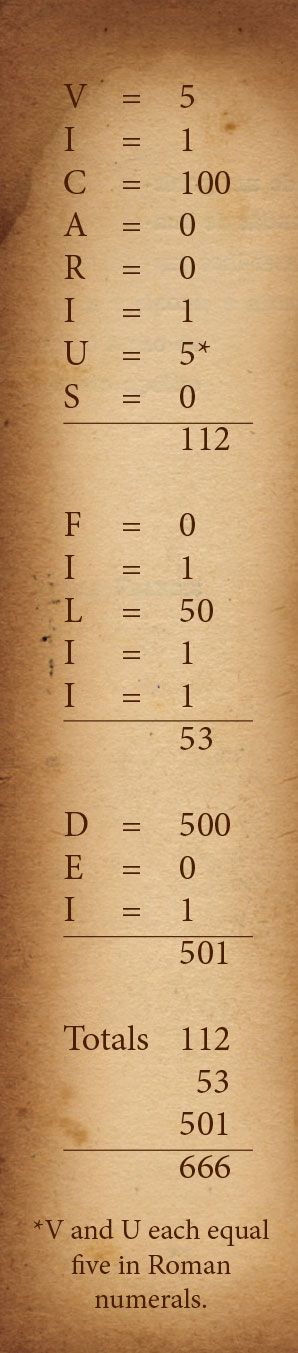
This verse says, “It is the number of a man,” and Revelation 15:2 refers to “the number of his name.” What man do you think of when you think of the papacy? Naturally, we think of the pope. What is his official name? Here is a Catholic quote: “The title of the pope of Rome is Vicarius Filii Dei” (English: “Vicar of the Son of God”).6 Malachi Martin, in The Keys of This Blood, uses the same title for the pope on page 114. A footnote for Revelation 13:18 in some Douay versions of the Bible says, “The numeral letters of his name shall make up this number.” Notice the chart at right, which shows what happens when we total up the Roman numeral value of the letters of the name. Again, the papacy fits the identification point. The beast with the “mark” is the papacy. No other power in history could possibly fit these 11 divine descriptive points. Now that we have positively identified the beast, we can discover her mark, or symbol of authority. But first, let’s look at God’s sign of authority.
1Andre Retif, The Catholic Spirit, trans. by Dom Aldhelm Dean, Vol. 88 of The Twentieth Century Encyclopedia of Catholicism (New York, Hawthorne Books, 1959), p. 85.
2Adolf Harnack, What is Christianity? trans. by Thomas Bailey Saunders (New York: Putnam, 2nd ed., rev., 1901), p. 270.
3Alexander Clarence Flick, The Rise of the Mediaeval Church (reprint: New York, Burt Franklin, 1959), pp. 148, 149.
4Joseph Rickaby, "The Modern Papacy," Lectures on the History of Religion, Lecture 24, (London: Catholic Truth Society, 1910), p. 1.
5Malachi Martin, The Keys of This Blood (New York, Simon & Schuster, 1990)
6"Answers to Readers' Questions," Our Sunday Visitor, Nov. 15, 1914.
2. What is God’s mark, or symbol, of authority?
“I also gave them My Sabbaths, to be a sign between them and Me, that they might know that I am the Lord who sanctifies them” (Ezekiel 20:12).
“It is a sign between Me and the children of Israel forever; for in six days the Lord made the heavens and the earth” (Exodus 31:17).
“He received the sign of circumcision, a seal of the righteousness of the faith which he had while still uncircumcised, that he might be the father of all those who believe, though they are uncircumcised, that righteousness might be imputed to them also” (Romans 4:11).
Answer: In these texts, God is saying that He gave us His Sabbath as a sign of His power to create and His power to sanctify (convert and save) us. In the Bible, the words seal, sign, mark, and token are used interchangeably.7 God’s sign, the Sabbath, represents His holy power to rule as Creator and Savior. Revelation 7:1–3 says it will be written upon the foreheads (minds—Hebrews 10:16) of His people. It will signify that they are owned by Him and have His character. Hebrews 4:4–10 confirms this by saying that when we enter His rest (receive salvation), we should keep His seventh-day Sabbath holy as a symbol, or mark, of salvation. True Sabbath keeping signifies that a person has surrendered his life to Jesus Christ and is willing to follow wherever Jesus leads. Since the symbol, mark, of God’s authority and power is His holy Sabbath day, it seems likely that the symbol, or mark, of God’s challenger—the beast—might also involve a holy day. Let’s see if it does.
7Compare Genesis 17:11 with Romans 4:11 and Revelation 7:3 with Ezekiel 9:4
3. What does the papacy say is her symbol, or mark, of authority?
Answer: Notice the following section from a Catholic catechism:
“Question: Have you any other way of proving that the Church has power to institute festivals of precept?
Answer: Had she not such power, she could not have done that in which all modern religionists agree with her—she could not have substituted the observance of Sunday the first day of the week, for the observance of Saturday the seventh day, a change for which there is no Scriptural authority.”8
The papacy is here saying that it “changed” Sabbath to Sunday and that virtually all churches accepted the new holy day. Thus, the papacy claims that Sunday as a holy day is the mark, or symbol, of her power and authority.
8Stephen Keenan, A Doctrinal Catechism [FRS No. 7.], (3rd American ed., rev.: New York, Edward Dunigan & Bro., 1876), p. 174.
4. Did God predict such an attempted change?
Answer: Yes. In describing the antichrist in Daniel 7:25, God said it would “intend to change times and law.”
A. How has the papacy tried to change God’s law? In three ways: In her catechisms she has (1) omitted the second commandment against veneration of images, and (2) shortened the fourth (Sabbath) commandment from 94 words to just eight. The Sabbath commandment (Exodus 20:8–11) clearly specifies Sabbath as the seventh day of the week. As changed by the papacy in its catechism, the commandment reads, “Remember that thou keep holy the Sabbath day.” Written thus, it can refer to any day. And, finally, she (3) divided the tenth commandment into two commandments.
B. How has the papacy attempted to change God’s times? In two ways: (1) She attempted to change the time of the Sabbath from the seventh day to the first day. (2) She also attempted to change God’s “timing” for the beginning and closing hours of the Sabbath. Instead of counting the Sabbath day from sundown Friday night to sundown Saturday night as God mandates (Leviticus 23:32), she adopted the pagan Roman custom of counting the day from midnight Saturday night to midnight Sunday night. God predicted these “changes” would be attempted by the beast, or antichrist.
Notice the following section from a Catholic catechism:
"Question: Which is the Sabbath day?
Answer: Saturday is the Sabbath day.
Question: Why do we observe Sunday instead of Saturday?
Answer: We observe Sunday instead of Saturday because the Catholic Church transferred the solemnity from Saturday to Sunday." 9
Here is another Catholic statement: "The Church is above the Bible and this transference of Sabbath observance from Saturday to Sunday is proof positive of that fact." 10
The papacy is saying in these references that its successful change of Sabbath observance to Sunday worship is proof that its authority is greater, or "above," Scripture.
9Peter Geiermann, The Convert's Catechism of Catholic Doctrine (St. Louis, B. Herder Book Co., 1957 ed.), p. 50.
10The Catholic Record (London, Ontario, Canada, Sept. 1, 1923).
5. How could anyone in good conscience attempt to change God’s holy day?
Answer: We ask the papacy, “Did you really change Sabbath to Sunday?” She replies, “Yes, we did. It is our symbol, or mark, of authority and power.” We ask, “How could you even think of doing that?” While it’s a pertinent question, the question the papacy officially asks Protestants is even more pertinent. Please read it carefully:
“You will tell me that Saturday was the Jewish Sabbath, but that the Christian Sabbath has been changed to Sunday. Changed! But by whom? Who has authority to change an express commandment of Almighty God? When God has spoken and said, Thou shalt keep holy the seventh day, who shall dare to say, Nay, thou mayest work and do all manner of worldly business on the seventh day; but thou shalt keep holy the first day in its stead? This is a most important question, which I know not how you can answer. You are a Protestant, and you profess to go by the Bible and the Bible only; and yet in so important a matter as the observance of one day in seven as a holy day, you go against the plain letter of the Bible, and put another day in the place of that day which the Bible has commanded. The command to keep holy the seventh day is one of the Ten Commandments; you believe that the other nine are still binding; who gave you authority to tamper with the fourth? If you are consistent with your own principles, if you really follow the Bible and the Bible only, you ought to be able to produce some portion of the New Testament in which this fourth commandment is expressly altered.”11
Tragically, both Catholicism and Protestantism stand in error for rejecting God’s Sabbath—His sign of identification.
11Library of Christian Doctrine: Why Don't You Keep Holy the Sabbath-Day? (London: Burns and Oates, Ltd.), pp. 3, 4.
6. What solemn warnings has God given regarding His law and His sign, or mark?
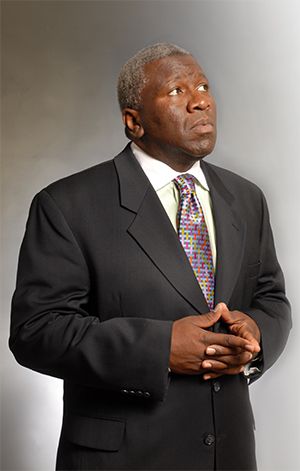
Answer: A. God warns religious leaders against causing people to stumble by saying that some commandments do not matter (Malachi 2:7–9). For example, some ministers teach, “It doesn’t matter what day you keep holy.”
B. God warns people who want their ministers to preach smooth fables rather than the truth about His law (Isaiah 30:9, 10).
C. God warns people about hardening their hearts against the truth of His law (Zechariah 7:12).
D. God states that the upheaval, tragedy, problems, and woes of earth come because people refuse to follow His law—and have even tried to change it (Isaiah 24:4–6).
E. God warns religious leaders who refuse to preach the prophecies of the end time (Isaiah 29:10, 11).
F. God warns that leaders who teach there is really no difference between sacred things (such as God’s holy Sabbath) and common things (such as Sunday) will face His indignation (Ezekiel 22:26, 31).

7. Revelation 13:16 says people will receive the mark of the beast in the forehead or in the hand. What does this mean?
Answer: The forehead represents the mind (Hebrews 10:16). A person will be marked in the forehead by a decision to keep Sunday as a holy day. The hand is a symbol of work (Ecclesiastes 9:10). A person will be marked in the hand by working on God’s holy Sabbath or by going along with Sunday laws for practical reasons (job, family, etc.). The sign, or mark, for either God or the beast will be invisible to people. You will, in essence, mark yourself by accepting either God’s mark—the Sabbath—or the beast’s mark—Sunday. Though invisible to men, God will know who has which mark (2 Timothy 2:19).
8. According to Isaiah 58:1, 13, 14, what decisive message does God deliver to His people in the last days?
“Cry aloud, spare not; lift up your voice like a trumpet; tell My people their transgression. ... If you turn away your foot from the Sabbath, from doing your pleasure on My holy day, and call the Sabbath a delight ... then you shall delight yourself in the Lord” (Isaiah 58:1, 13, 14).
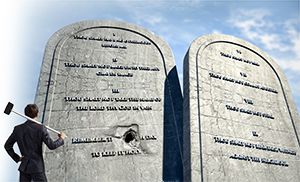
Answer: He says to tell His people that they are sinning because they are trampling on His holy day, and He asks them to quit breaking the Sabbath so He can bless them. He wants His messenger to speak loudly so the people will hear. Notice that the third angel of Revelation 14:9–12, who brings the message about the mark of the beast, speaks with a loud voice also (verse 9). The message is too important to treat as ordinary. It’s a life-or-death issue! Jesus says His sheep, or people, will follow Him when He calls them (John 10:16, 27).
9. Do people who worship on Sunday as a holy day have the mark of the beast now?
Answer: Absolutely not! No one will have the mark of the beast until Sunday worship becomes an issue forced by law. At that time, those who decide to follow the false teachings of the beast and worship on Sunday—the beast’s counterfeit holy day—will receive his mark. Those who follow Jesus and obey His truth will keep His Sabbath day holy and receive His mark. Those who expect to refuse the beast’s mark in the future must step under Jesus’ Sabbath banner now. His power is available to those who obey Him (Acts 5:32). Without Him, we can do nothing (John 15:5).
With Him, all things are possible (Mark 10:27).

10. According to the book of Revelation, who did John see in God’s eternal kingdom?
Answer: The answer is threefold and very clear:
A. Those who have God’s mark—sign (His Sabbath)—in their foreheads (Revelation 7:3, 4).
B. Those who refused to identify with the beast or his image and who refused to have his mark or name in their foreheads (Revelation 15:2).
C. The people who—today and for eternity—follow where Jesus leads, trusting Him fully in everything (Revelation 14:4).
11. What is Jesus saying to people today?
“He who follows Me shall not walk in darkness, but have the light of life” (John 8:12).
Answer: What a fantastic promise! If we follow Him, we will not end up in darkness but will, instead, have glorious truth. Further, following Him and keeping His Sabbath will put God’s mark on our foreheads and protect us from the dreadful plagues (Psalm 91:10) that will fall upon the disobedient (Revelation 16). It also marks us as ready for translation at Jesus’ second coming. What blessed protection and assurance God has offered us!
An Urgent Alert
You will discover more astounding information as you study the final three Study Guides of the nine that deal with the three angels’ messages of Revelation 14:6–14. These Study Guides will explain (1) the role of the United States in earth’s final conflict, (2) how churches and religions of the world will be involved, (3) what world conditions will precipitate earth’s final battle, and (4) Satan’s amazing strategy for deceiving billions. If you are wondering what Protestant churches have to say about the papal claim for changing Sabbath to Sunday, quotes appearing on the next two pages will provide the shocking answers.
12. God is asking you to keep His holy seventh-day Sabbath as a sign that you have accepted His salvation and will follow Him wherever He leads. Will you decide now to begin keeping His Sabbath holy?
Answer:
Thought Questions
Comments from Churches and Other Authorities About the Sabbath
Answer: Baptist: “There was and is a commandment to keep holy the Sabbath day, but that Sabbath day was not Sunday. ... It will be said, however, and with some show of triumph, that the Sabbath was transferred from the seventh to the first day of the week. ... Where can the record of such a transaction be found? Not in the New Testament—absolutely not. There is no scriptural evidence of the change of the Sabbath institution from the seventh to the first day of the week.” Dr. Edward T. Hiscox, author of The Baptist Manual, in a paper read before a New York ministers' conference held Nov. 13, 1893.
Catholic: “You may read the Bible from Genesis to Revelation, and you will not find a single line authorizing the sanctification of Sunday. The Scriptures enforce the religious observance of Saturday, a day which [Catholics] never sanctify.” James Cardinal Gibbons, The Faith of Our Fathers, 93rd edition, 1917, p. 58.
Church of Christ: “Finally, we have the testimony of Christ on this subject. In Mark 2:27, he says: ‘The Sabbath was made for man, and not man for the Sabbath.’ From this passage it is evident that the Sabbath was made not merely for the Israelites, as Paley and Hengstenberg would have us believe, but for man ... that is, for the race. Hence we conclude that the Sabbath was sanctified from the beginning, and that it was given to Adam, even in Eden, as one of those primeval institutions that God ordained for the happiness of all men.” Robert Milligan, Scheme of Redemption, (St. Louis, The Bethany Press, 1962), p. 165.
Congregationalist: “The Christian Sabbath [Sunday] is not in the Scriptures, and was not by the primitive church called the Sabbath.” Dwight's Theology, Vol. 4, p. 401.
Episcopal: “Sunday (Dies Solis, of the Roman calendar, ‘day of the sun,’ because dedicated to the sun), the first day of the week, was adopted by the early Christians as a day of worship. ... No regulations for its observance are laid down in the New Testament, nor, indeed, is its observance even enjoined.” "Sunday," A Religious Encyclopedia, Vol. 3, (New York, Funk and Wagnalls, 1883) p. 2259.
Lutheran: “The observance of the Lord’s day [Sunday] is founded not on any command of God, but on the authority of the church.” Augsburg Confession of Faith, quoted in Catholic Sabbath Manual, Part 2, Chapter 1, Section 10.
Methodist: “Take the matter of Sunday. There are indications in the New Testament as to how the church came to keep the first day of the week as its day of worship, but there is no passage telling Christians to keep that day, or to transfer the Jewish Sabbath to that day.” Harris Franklin Rall, Christian Advocate, July 2, 1942.
Moody Bible Institute: “The Sabbath was binding in Eden, and it has been in force ever since. This fourth commandment begins with the word ‘remember,’ showing that the Sabbath already existed when God wrote the law on the tables of stone at Sinai. How can men claim that this one commandment has been done away with when they will admit that the other nine are still binding?” D. L. Moody, Weighed and Wanting, p. 47.
Presbyterian: “Until, therefore, it can be shown that the whole moral law has been repealed, the Sabbath will stand. ... The teaching of Christ confirms the perpetuity of the Sabbath.” T. C. Blake, D.D., Theology Condensed, pp. 474, 475.
Pentecostal: “ ‘Why do we worship on Sunday? Doesn’t the Bible teach us that Saturday should be the Lord’s Day?’ ... Apparently we will have to seek the answer from some other source than the New Testament” David A. Womack, "Is Sunday the Lord's Day?" The Pentecostal Evangel, Aug. 9, 1959, No. 2361, p. 3.
Encyclopedia: “Sunday was a name given by the heathens to the first day of the week, because it was the day on which they worshipped the sun. ... The seventh day was blessed and hallowed by God himself, and ... he requires His creatures to keep it holy to Him. This commandment is of universal and perpetual obligation.”Eadie's Biblical Cyclopedia, 1890 ed., p. 561.
Quiz Questions
1. Many people have already received the mark of the beast. (1)
_____ Yes.
_____ No.
2. The mark of the beast is (1)
_____ Your Social Security number.
_____ Sunday as a holy day.
_____ The bar codes for grocery pricing.
3. The beast organization that has the mark is the (1)
_____ United Nations.
_____ Papacy.
_____ European Union.
_____ Trilateral Commission.
4. The mark is literal and will be seen by all. (1)
_____ Yes.
_____ No.
5. God also has a mark, or symbol, of His power and authority. (1)
_____ Yes.
_____ No.
6. God's mark of authority is (1)
_____ A secret number that is given to each faithful Christian.
_____ Speaking in tongues.
_____ Sabbath-keeping in commemoration of Creation and sanctification.
_____ Baptism.
7. How did the "beast" attempt to change God's law? (2)
_____ Changing Sabbath (of the fourth commandment) to Sunday.
_____ Teaching that it is not a sin to commit adultery.
_____ Removing the commandment against the veneration of images.
8. In Bible prophecy, how long is 42 months? (1)
_____ 420 literal years.
_____ Three and one-half literal years.
_____ 1,260 literal days.
_____ 1,260 literal years.
9. Where will the beast's mark be placed? (2)
_____ In the hand.
_____ On the mouth.
_____ On the cheek.
_____ In the forehead.
10. Where will God's mark be placed? (1)
_____ On the hand.
_____ In the forehead.
_____ On the person's tongue.
11. Which of the three angels' messages is the warning against the mark of the beast? (1)
_____ First angel's message.
_____ Second angel's message.
_____ Third angel's message.
12. The beast attempted to change God's times by (2)
_____ Celebrating New Year's as a holiday.
_____ Changing God's holy day from the seventh to the first day of the week.
_____ Setting the hours for God's holy day as midnight-to-midnight instead of sundown-to-sundown.
13. Jesus gave us the warning message regarding the mark of the beast. (1)
_____ Yes.
_____ No.
14. Sign, mark, seal, and token are used interchangeably in Scripture. (1)
_____ Yes.
_____ No.
15. There is no scriptural authorization for observing Sunday as a holy day. (1)
_____ True.
_____ False.
16. I believe I should begin keeping God’s seventh-day Sabbath (Saturday) as His holy day.
_____ Yes.
_____ No.